Thursday, November 18, 2010

#196 The Fly (1986)

****

Director: David Cronenberg

Cast: Jeff Goldblum, Geena Davis, John Getz, Joy Boushel, Leslie Carlson, George Chuvalo

Cronenberg explores the consequences of science, medicine, and technology going too far in this gruesome thriller, horror romance. Jeff Goldblum plays a lonely (though absolutely ripped?) scientist who has just secretly solved the mystery of teleportation! Geena Davis arrives as a reporter, learning about the project for a book. Together, as they explore the possibility of teleporting live organisms, the two fall in love in a fast, steamy love affair.

In a fit of drunken jealousy, Goldblum decides to teleport himself in his woman's absence, and what he initially thinks is a purification of his genes is actually much more horrific: his genes have been fused with that of a house fly that was also in the teleporter.

As he slowly transforms and degenerates, the two lovers are both forced to deal what comes. Goldblum begins to lose control over his body and his mind, and Davis finds some shocking news at the doctor's that sends the plot into entire other arena of intense.

What could've simply been a scary gore-fest turned out to be a highly emotional, political film. Being a true horror-movie-hater myself, I was gearing myself up for a 90 minute struggle. Instead, I found it to be pretty fascinating, and I didn't ever even have to look away! The ending was so sad and overwhelming that I felt tears welling, though one never fell. Awesome movie, but disappointed to see it had such an obvious lead for a sequel. Heard it wasn't as good, but I don't plan on trying to find out!

Wednesday, November 17, 2010

#195 Sherman's March (1986)

***

Director: Ross McElwee

Cast: Ross McElwee, Burt Reynolds, Charleen Swansea

Like so many others, I was duped by this film. I nestled down on top of my comforter for what I assumed was going to be a 2 hour long documentary on Sherman with some sort of odd sprinkling of personal-sharing on the part of the film-maker (as I had read in the film description). What I found, however, was one of the first and most noted diary films of the documentary genre.

Ross McElwee is a southerner who is about to start a film that retraces Sherman's march through the south, researching the southerners that are still affected by his legacy. Instead, he is caught off guard by his girlfriend leaving him for her ex just before he begins his journey. Thus, he has a hard time concentrating on Sherman and begins to instead be side-tracked by his own personal shortcomings as a lover, boyfriend, and person.

He begins to explore countless past relationships as well as new relationships set up by his rather determined match-maker friends. Soon, his film becomes almost entirely about this journey with the occasional "Oh, right! Back to Sherman!" moments. One of the greatest moments of this film comes with mindfulness realization that he is not just filming his own life, but perhaps he is filming to HAVE a life. In other words, he begins using his filming as an escape and an excuse.

The self-aware, diary-style film is a very slow moving, plotless exploration of one man's experience of the human condition. The answerless, romantic-comedyless search for companionship and success. For the most part, I loved this film--as I usually always love documentary films! Although interesting and sometimes masterfully edited, I found myself somewhat inattentive at parts–whether that is my own fault or the film-makers is undetermined. See for yourself.

Tuesday, November 16, 2010

#194 Duck Soup (1933)


*****

Director: Leo McCarey

Cast: Groucho Marx, Harpo Marx, Chico Marx, Zeppo Marx, Margaret Dumont, Raquel Torres, Louis Calhern

One of the Marx brothers most famous films, but certainly not their most successful at the time of its release, Duck Soup is a plotless, confusing hour of silliness-- brilliant! Groucho plays Rufus T. Firefly, the new leader of Freedonia-- a country financially supported soley by his sometimes love-interest, Mrs. Teasdale. However, the leader of Sylvania (played by Calhern), wants to win Mrs. Teasdale affections and eventually goes to war with Freedonia for well, no particular reason.

The truth of the matter is, the plot of this movie is completely pointless and incidental. Though often called one of the greatest political and war satires ever, I mostly just see a brand of comedy that is unparalleled. After this film tanked in box offices, the brothers left Paramount and began making movies with MGM that were more musical and certainly more structured.

If nothing else demonstrates the randomness of Duck Soup, then perhaps Groucho Marx's explanation of the title will: "Take two turkeys, one goose, four cabbages, but no duck, and mix them together. After one taste, you'll duck soup the rest of your life."

I came into this movie expecting something silent and extremely unapproachable, and I was so SO pleasantly surprised. Not only is this film easy to watch, but it is also so goofy that it is impossible not to love it. The Marx Brothers' camera-aware one-liners are sometimes poorly delivered, and the screen presences are extremely unorganized/unplanned-- making the film feel like a bad stage-show, and absolutely amazing for that reason. In all of the places where we expect modern cinema to do the opposite, the Marx Brothers get away with just about everything. SO love this film, and I am adding it to my list of "must watch again"s.

Monday, November 15, 2010

#193 Au Revoir Les Enfants (1987)


***

Director: Louis Malle

Cast: Gaspard Manesse, Raphael Fejt ö, Francine Racette, Stanislas Carre de Malberg, Philippe Morier-Genoud, Francois Berléand, Francois Négret

In the midst of World War II, two Catholic boarding school students in France find unexpected friendship. Julien Quentin (Manesse) is a sensitive, momma's boy who despite his hatred for school has a decent amount of popularity amongst the other boys. Jean Bonnet (Fetjö) is a newcomer to the school and is finding it hard to adjust.

When Julien learns that Jean is actually a Jew in hiding, he stops taunting him with the other boys and slowly develops a friendship with him. When Gestapo receive word that the school is hiding Jews and come for Jean, Julien faces one of the hardest days of his life.

Based on the actual events of his childhood at a wartime boarding school, director Louis Malle is careful to depict the film entirely from the child's view. No omniscient understanding of the war-- only what the priests and teachers tell the children (practically nothing). This view allows for a true innocence in perspective that makes the emotions of the children completely within our empathetic grasp as viewers. In addition, the film is shot in a dark, snowy, damp setting that chills you in just watching. The title translated to English ("Goodbye, Children") refers to both the climactic departing at the film's conclusion as well as the unavoidable end of childhood innocence.

The film uses a series of interesting motifs to highlight the unusual unification of these two characters, ie. continually reminding you of their separation, even when shown together. One of the strongest motifs I noticed is the visual of the "looking glass." The character Bonnet is consistently viewed through glass, in reflection, or in a window-like frame-- and more often than not, we find that it is Quentin who views him through this frame. (Think of the piano lesson window, the mirror in Bonnet's locker, the doorway of Bonnet's exit, the framed soldier who comes for confession.) Also remember the opening scene of the movie where we watch Quentin look out through the train window, trapped and isolated, with a distinct naive view of the world. It is when viewing Bonnet through these frames that illuminates the importance difference between the two friends--it reminds us that even though they are mates, they are still very isolated, coming from two very different worlds.

Another beautiful and tragic perspective on World War II--refreshing and endearing for its unique vantage point on the happenings of the Holocaust. Of course, this film is only minutely in documentation of the war-- and more about the climax and denouement of friendship as a result of persecution. A microcosm scope.


Sunday, November 14, 2010

#192 Rebel Without A Cause (1955)


***

Director: Nicholas Ray

Cast: James Dean, Natalie Wood, Sal Mineo, Jim Backus, Ann Doran, Corey Allen, William Hopper, Rochelle Hudson, Dennis Hopper, Edward Platt

Jim Stark is from a middle class family who doesn't know how to love him. They move him from town to town to keep him out of trouble, and in particular, his father is about as far as can be from the "be a man" role model. When he comes to this new town, Jim finally begins to find the affection he's been searching for, albeit in unusual places: Plato, a ruffian kid, Judy, a love-starved daughter and bully's girlfriend, and Ray, a juvenile delinquent detective.

Unfortunately, even though he makes a go at starting a-new, other kids in the new town are making it anything but easy-- forcing him to knife fight, play chicken, race stolen cars, and the like. When Plato's deeply disturbed antics take center-stage in a shoot-out with police, Jim does what he can to defend his first and only friends.

James Dean is Jim, and Dean is a Brando-esque screen presence. The mumbles, the squint, and the nonchalant command of the screen-- he is pretty electric in this film. Interestingly enough, Brando actually screen-tested and turned down this role, so the similarity in Dean's acting style for this film to Brando is not-so-surprising. Natalie Wood-- how DOES this girl keep landing roles across these bo-hunks?? William Beatty AND James Dean?? Frankly, I'm finding her to be a bit under-whelming as an actress.

The plot of this film is so bizarre that I am truly baffled at its enormity of "classic" respect. Granted, it's all about James Dean, isn't it? I mean... I had a poster of him on my wall from this film (never even having seen it) for the majority of my junior year of college.

Anyway, like I was saying... BIZARRE plot. Lots of unnecessary characters and subplots in this film-- lots of details that confuse and are never elaborated on. Many things mentioned but never explained. Who is this woman caring for Plato-- and why does she keep re-appearing in such a random, unsupported fashion? No one really got too upset about Buzz's death, did they? And is the subplot of Judy's father really need to be there? All it did was open up doors of confusion-- is she sexually attracted to her own father?

What?

Mostly, I just tried to "let go" with this film. Suspend disbelief, and try not to be so hung up on the odd turns this film took me down. Obviously this film is loved for its actor performances and certainly not for its storyline, so I'll try to appreciate it in the same light.

#191 Gentlemen Prefer Blondes (1953)


***

Director: Howard Hawks

Cast: Jane Russell, Marilyn Monroe, Charles Coburn, Elliot Reed, Tommy Noonan, Carol Channing

An exceptionally comedic, light-hearted musical performance from both Russell and Monroe, playing two showgirl friends on their way to Paris. Lorelei Lee (Monroe) is engaged to be married, and unbeknownst to her and her friend Dorothy (Russell), she is being followed by a private investigator hired by her fiance's father. He wants to make sure she isn't marrying his son for just his money, and well, she just might be. "But is that so wrong?"

The musical numbers are sparkly and are meant to razzle-dazzle you. Monroe is over-the-top and purrs out her lines with unbridled sexuality. Though nothing to take too seriously, the film is a must-see for its most unusual brand of comedy and sex appeal. Russell is absolutely tranny-tastic as Dorothy-- LOVE IT!


Tuesday, November 9, 2010

#190 My Brilliant Career (1979)

**

Director: Gillian Armstrong

Cast: Judy Davis, Sam Neill, Wendy Hughes, Robert Grubb, Max Cullen, Aileen Britton, Peter Whitford, Patricia Kennedy, Alan Hopgood, Julia Blake

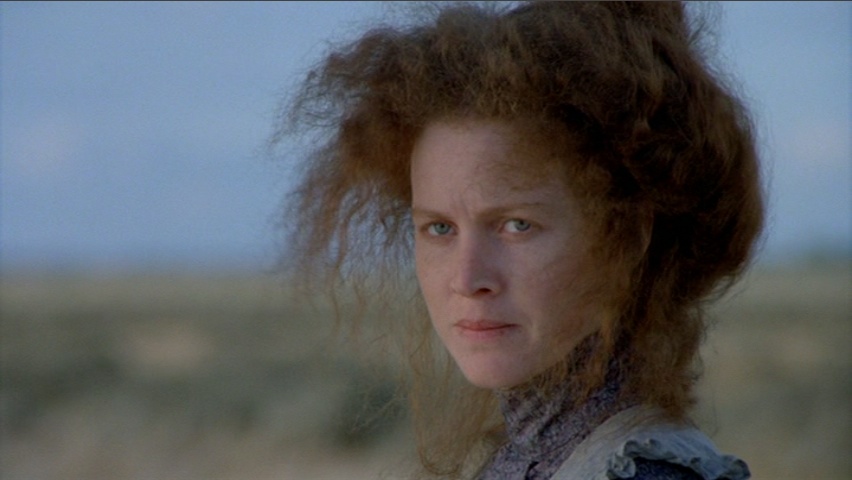
Now, I've never been huge on romances-- for me, they are truly a rare-to-sometimes food. But I had some decent hope for this film: a headstrong feminist protagonist, a period piece, and with excellent reviews! Unfortunately, I spent most of the time during this film wondering how it ever made the 1001 list-- and haven't I seen this before on Lifetime?

Sybylla Melvyn (Davis) is an ugly woman, and she is struggling against 19th century societal conventions to settle down and get married. She seems dead-set on starting a career in art, literature, or music, and the film is based around her struggle to fulfill that goal. In fact, the film even opens with a grandiose monologue about her brilliant career-- so brilliant, in fact, that we never need to see her doing it or ever even find out what it is she decides to do!

A number of stuffy and I guess supposedly "hunky" suitors and stubborn family members attempt to derail her plans, but Sybylla does her best to not forget herself.

For one, if you're going to call the film "my brilliant career"-- then perhaps the person should HAVE a career. Or at least a more specific ambition. Secondly, the main suitor, Harry Beecham(played by Sam Neill), is supposed to be a hard conflict of interest for Sybylla, but it was hardly convincing. Their romance really rang dead-as-a-doornail, lacking passion or ferocity (which I think was supposed to be a major aspect of Davis' character), and frankly... I just wasn't buying it.

The film was kind of a cheesy snore, and I found myself wishing that I was watching Pride and Prejudice, Marie Antoinette, or countless other romance/period piece films that I enjoy far more than this one. I'd say unless you're okay with being underwhelmed or unless you're a HUGE sucker for any romance film in existence, it's really okay to skip this one.